Tuesday, February 26, 2013

Riding Away Again in Margaritaville...


“Why do I love Key West so much?  If you had ever been there, this question would not need to be asked.” ~Me

My favorite watering hole in Key West, the Rum Bar at the
Speakeasy Inn. This architectural style is dominant
throughout the island.

Key West is one of my absolute favorite places.  It’s a sub-tropical New Orleans, a sanctuary from the rat race of Miami, a place to get away, or a place to hideaway.  Warm turquoise waters, rustic small town charm, an artistic uniqueness second to none, a population of people who love where they live, and a lively bar and restaurant scene…what’s not to love?  And lucky me, it is only a 3.5 hour drive from Miami, over dozens of scenic bridges through dozens more island towns.  It is decadent to the eyes, and energizing to the soul.
Key West is a town that has its roots back to salvaging, fishing, and wrecking in the early 1800’s.  Today, Cayo Hueso, or Key West, is home to a Navy base, artists, entrepreneurs, fishermen, and a thriving tourism industry.  People come from all over the world to partake in fishing, diving, shopping, festivals, watersports, lounging around tropical resorts and beachfronts, and partying on world famous Duval Street, with its funky art galleries, local restaurants, and bars galore.  With over 360 liquor licenses registered in Key West, there is no shortage of places to wet your palate!

Turquoise waters off Key West

Riding in Key West is its own kind of magic.  I’ve been doing it for many years, but each time I return, I find something new and interesting.  The water is warm…in the summertime it can be 84 degrees!  In many places, it is crystal clear and abundant with reef fish and sea turtles.  This past weekend was no exception!  A warmer than average February has yielded a surprising number of riding days without the need for a wetsuit.  Having friends in Old Town that generously accommodate my constant thirst for Key West is quite advantageous, as lodging in the peak of tourist season can be quite expensive. 

Riviera Canal

There are a few places around town to launch.  I used to pay the $20 fee to launch at Garrison Bight…until I accidentally found out about a nice quiet, unadvertised and free public ramp off  Riviera Canal, near the airport.  The cruise down the longish canal provides you with a nice view into the backyards of the few lucky residents on the island with private deepwater dockage (most everywhere else there are only commercial marinas).
Once you emerge from the canal into Cow Key Channel, you are rewarded with a bustling hub of water activity…boat and kayak rentals, standup paddleboarders on a tour, some people fishing from the bridge, other boats pulling away from restaurant docks.  And all in the most amazingly clear, emerald colored water.  There are a few outfits that do jet ski tours around the island.  They can be found buzzing by in groups of 10 or more. 
After taking a leisurely cruise around the south perimeter of the island and riding past Fort Zachary Taylor State Park, the main boating channel into Key West Harbor comes into view.  Rounding the corner into deeper water, massive cruise ships line the seawall at the Truman Waterfront.  If you have never had the chance to ride alongside a cruise ship from your ski, then you have never felt like a tiny speck of a vessel.  Key West Harbor is a busy marine traffic area.  Boats of all shapes and sizes and with many purposes constantly traverse through it…sailing charters, commercial shrimp boats, noisy party boats, jet ski tours, private vessels heading out to fish or dive.  There is also a sizeable anchorage full of sailboats to navigate through, many housing Key West’s notorious population of liveaboards. 

A tranquil hiding space in the mangroves

It is beyond the mooring field and Sunset Key that one can see a bounty of tiny uninhabited islets.  I am drawn to these like a cat to a can opener.  It is here that you can hide, leave the sounds and crowds on shore behind, and simply relax to the sounds of birds, distant boat engines, and snappers leaping from the water’s surface.  It is hard to imagine that something so remote and tranquil can be found so close to civilization, but it can.  It is one of the thousands of reason I love the Keys.
A 5 mile trek further east brings you to a great little attraction, that can only be reached by boat…the submarine pits on Big Coppitt Key.  They are a series of 40 – 50’ deep trenches that are dug out of the bedrock in a remote, undeveloped area surrounded by woods.  At the end of one of the trenches is a rope swing, obviously hung by locals from a sturdy old casuarina tree.

Friendly dock space at Hurricane Hole

No afternoon would be complete without a dockside bar stop.  I prefer to sneak into Hurricane Hole, a scenic and protected cove right at the base of the Stock Island bridge.  Come as you are, all are welcome.  They have a great selection of appetizers and bar grub, to be washed down with a refreshing brew, all at a reasonable price.  And if you stick around long enough, the karaoke machine comes out!  Proceed at your own risk!

Sea and sky blend seamlessly near dusk

Ah yes, and finally, the dreamy Key West sunset.  Most visitors to Key West try to catch the fiery orb descending toward the horizon from the street performer mecca of Mallory Square, while being entertained by people swallowing swords and walking on glass, and cats jumping through hoops of fire.  And while that is certainly a great place to enjoy it from, I am rather partial to a quiet sunset at sea.  Leaving Hurricane Hole, I meander back out to the Atlantic, maybe half a mile offshore, and just drift and watch another changing of the guard between the day and the twilight.  The prize at the end of the journey.
But now…the sun is down, and it is time to head in.  There are 360 liquor licenses needing attention in town, and I do not intend to let them down!  Have nary a doubt in your mind, Cayo Hueso, I will be back. 

Key West sunset from a Seadoo point of view


Tuesday, February 19, 2013

A Friend With a Dock is a Friend Indeed

“There are big ships and small ships.  But the best ship of all is friendship”.  ~Author Unknown

Boaters are a friendly crowd…and quite a social lot!  Any popular lake or sandbar is expectedly loaded with groups of anchored boaters having BBQs, swimming, and playing music on a sunny summer weekend.  But there is another kind of marine socialization, and it’s super fun…visiting friends by water!  I am not sure why it is, but arriving at someone’s home by waterway, or arriving at a restaurant’s dock instead of its parking lot, is SO much more fun! 
There can be many reasons for this.  You get to avoid traffic.  The scenery is superb.  Dolphins are nicer than motorists.  You are floating.  It is awesome.

Hi Dave, I'm here!

Traveling to visit friends on my Seadoo is a favorite past time.  And since PWC are small, they fit almost anywhere.  Thanks to the reverse function that most skis have nowadays, they are also highly maneuverable.  I have parked anywhere from alongside the dock, to upon a floating vessel platform, to tying the ski to two random available anchor points (including low hanging branches and partially submerged canal junk) in the vicinity, or even in between other docked boats.  I have been hoisted up on boat lifts.  But the end result is always the same; an enthusiastic smiling friend and the promise of an ice cold beer!  Unless you pull up at the wrong dock, in which case you are met with an angry, yelling homeowner and a Rottweiler!

Scratch-free docking using the corner method, at Shuckers Raw Bar .

I can offer a few suggestions for docking your ski in a new or unfamiliar location: those of you that ride and deal with docks know that the #1 place where most of the ski’s scratches and dings come from is the dock.  Skis are small and easily get washed underneath the dock and bumped into the concrete edges.  Because of their shape, they have a lot of painted surface area that is very vulnerable to impact with all kinds of things at docks.  And thanks to manufacturers’ recent obsession with dark colored hulls, scratches and chips are more devastating to the eye than they need to be. All it takes is a passing boat wake to rack your ski into an incriminating dock protrusion and leave you with a symbolic gash.  The key to successful damage-free docking is finding two points to tie the ski between, that are not parallel to the wall or dock itself.  Securing it caddy-corner is ideal.  I always look for corners with a 90 degree bend, and I tie it at a 45 degree angle between two anchor points.  This way if a wake comes by, the ski isn’t slammed right into the dock, as it would be if it were simply tied parallel to the dock.  Alternatively, you could find any way to secure it that holds it away from the wall.  One technique, if the environment is right, is to toss your anchor off the front of the ski and then have a rear line that gets secured to something on land.  This holds it away from the dock or shore and will also hopefully prevent it from bottoming out in shallow shoreline.
Hope you don't mind I brought a few friends home...
Make certain that you keep the tides in mind while you whittle away the hours with your waterfront buddies.  If the tide goes out while you are there, and you haven’t checked your ski, you may come back to find it hung up on your lines.  Or if the tide has come in, there may be too much line out and your ski is now freely bumping into things (and getting scratched!).  Try to remember to check on your trusty vessel sometime before your fifth margarita!
One last thing…anytime you are visiting by water, you are a guest in their waterway, whatever type it is.  Always approach docks at low speed, and travel at full idle when in canals where boats are docked.  Despite their small size, skis throw a lot of water, even at low speeds.  Get off the gas and be a good denizen to our sport, as well as a courteous boater.
I hope Debbie doesn't mind if I borrow the pool...
Now that you are satisfactorily docked…go onshore and be social!  Before all that’s left for you are two burnt hot dogs and a warm beer.

Tuesday, February 12, 2013

There's No Show Like a Boat Show!


“Should you find yourself in a chronically leaking boat, energy devoted to changing vessels is likely to be more productive than energy devoted to patching leaks” ~Warren Buffett


What do Furuno radars, teak decking distributors, Bombardier E-Tecs, Sea Rays, Sea Doos, propane-powered eco outboards, and modular docking systems have in common?  They can all be found under one temporary roof, at a boat show near you!

It’s boat show season again.  Marine dealers and product inventors are smart…why not take advantage of the boating doldrums of mid-winter to start getting people thinking about the water again?  Believe it or not, spring is right around the corner, and these guys know it.  Whether you are in the market for a new boat or PWC, or just looking for a fun place to spend an afternoon dreaming, a boat show may be just the ticket.

The Miami International Boat Show is massive.  It is divided between 3 different locations: the Miami Beach Convention Center and two local area marinas.  It is truly a boater’s paradise.  Boats from nearly every manufacturer are showcased under gleaming lights, and are open to boarding.  Every accessory you can imagine – and some you cannot – is also on display.  It is a fantastic time to get a sampling of everything out there.  There are electronics and cleaning products, rods & reels, dive gear, innovative new dock ladders, clothes and sandals, representatives from charter boat vacations and Caribbean islands.  The list goes on and on.


Kawasaki, Yamaha, Seadoo...oh my!

The good news is, PWC have a healthy representation at most shows.  Their growing popularity as affordable family water recreation has steadily drawn up sales figures over all manufacturers.  The increased reliability, innovative creature comforts, ease of towing and storage, and environmentally friendly reputation make PWC an instant success.  Plus let’s face it, they’re slick, shiny, colorful, powerful, fun, and just generally bad ass.  And if all that isn’t enough to make you want to run right out and get one, boat shows are almost guaranteed to offer special incentives to buyers, like a $500 discount in purchase price, or a free or deeply discounted extended warranty plan. 

Let’s not forget the accessories!  Few things have more accessories than boats.  For PWC that includes special easy-load trailers, aftermarket rear boarding steps, a plethora of different life jacket styles, water skis and wake boards, towable water toys, anchors and toolkits especially for PWC, seat covers and traction mats, performance modification upgrades and parts.  Local dealers usually provide the vessels on display, and can often do sales right there on the spot, including financing.  After all, boat show vendors are there to sell you stuff.

Make sure you take some time to visit the towing insurance, boat insurance, and boating legislators’ booths.  All kinds of boating interests are represented, and it is a great time to get educated on the laws and regulations affecting (or threatening) your boating style.  Also consider signing up for a boater safety course.  They are always represented at shows as well.

Don’t let the winter drear keep you down!  Get that driveway cleared of snow, and get yourself out to your area boat show this winter.  And I totally wouldn’t be mad at you if you came home with a nice new PWC just in time for spring! J
I condone the purchase of skis when there is snow on the ground!

Tuesday, February 5, 2013

Those @#$% Trailer Lights!

“Electricity is really just organized lightning.” ~George Carlin

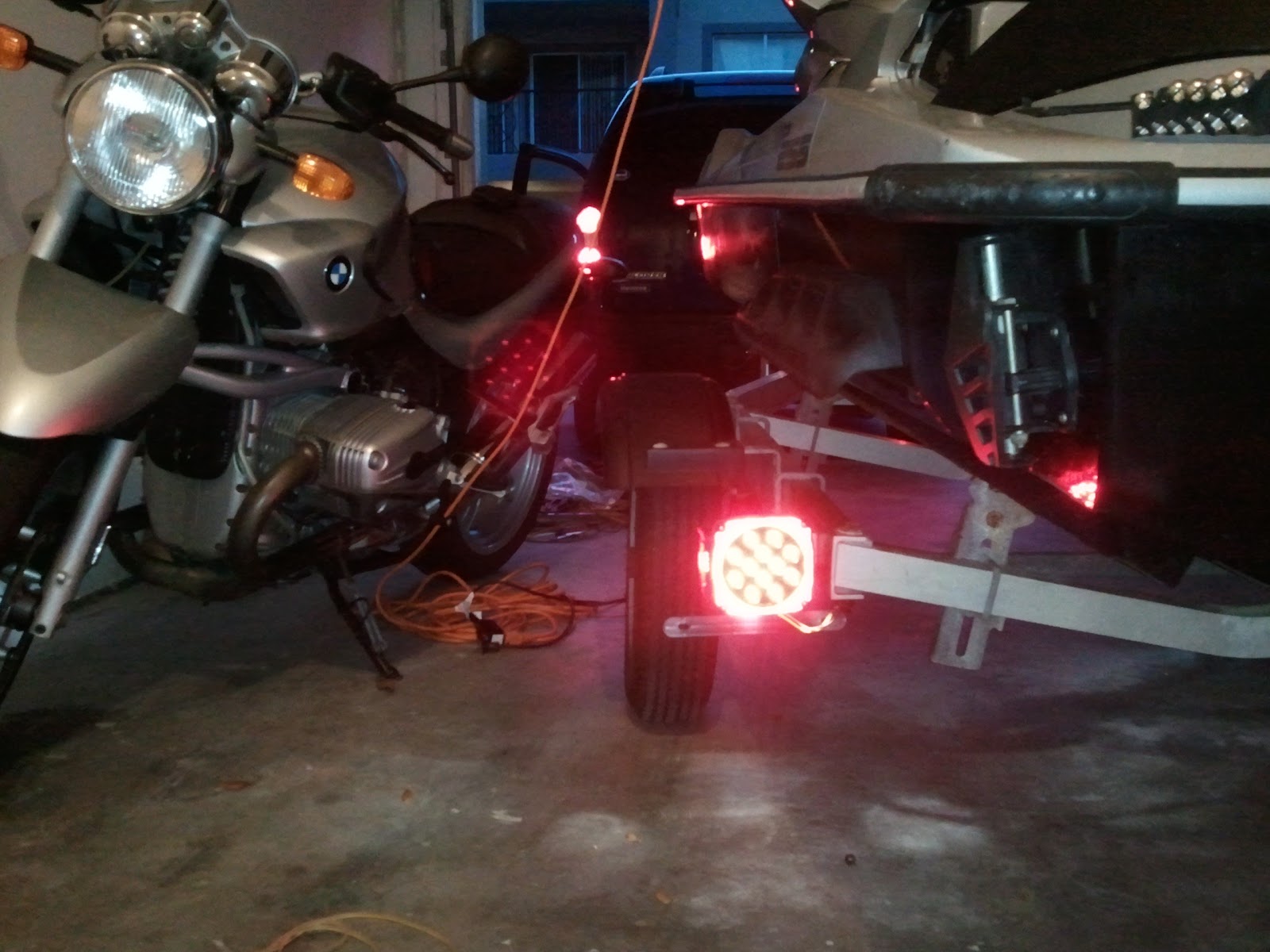
The Elusive Fully Working Trailer Lights…it seems so simple.  A coated set of wires that run from an insulated plug at the rear of the tow vehicle, to a few light assemblies.  And yet I cannot recall the last time ALL of my trailer lights were illuminated simultaneously.  As in not flickering, partially mysteriously dimmed on one side, stuck in brake light mode, or just out all together.  We’ve all been there…you haul out at the end of a long day, and have an hour of driving to do in the dark to get home.  You’ve done everything right, including remembering to unplug the lights before backing the trailer into the water.  And when you plug them back in…[crickets].
I often wonder how it is that we can splice atomic particles, build lightning fast processor chips the size of a breadcrumb that could run the power grid for an entire city, and successfully land an exploratory rover on a distant planet, and yet CANNOT seem to develop a set of trailer lights that work beyond the day you buy the trailer and bring it home for the first time!
I get it…we are submerging electrical components in water…some of us saltwater…and we all know that water and electricity do not mix.  But alas, there are amazing products out there that can (or should) effectively seal out water.  As the (un)proud owner of a second set of “sealed” LED trailer lights in the last 6 months, I can tell you I am quite disappointed in the poor build quality of these units.  My original trailer lights were the style referred to as ‘dry launch’, meaning that they purposely have an opening on the bottom, so that when the assembly gets submerged in water, an air pocket forms that is large enough to keep the connection point at the bulb dry (derisive snort).  Sort of like if you were to take an empty upside down drinking glass and put it into a bucket of water.  Provided that you do not turn the glass sideways, the air pocket stays in the glass, no matter how far down you push the glass.  Yeah…they don’t work real well.
But there was a lot of clamor about these great new LED trailer lights.  The light assemblies are (advertised to be) sealed, thus removing the corrosion at the bulb connection problem from the equation.  Of course there are other places that shorts can happen (at the plug from the tow vehicle, a damaged ground wire, damaged or severed wire somewhere along the trailer frame), but in my experience, most blown trailer lights were the result of the connections getting wet at the rear light assembly.  So I was thinking, “Great!  I am so getting sealed lights, even if they are ridiculously expensive!” 
I happily dismantled the stock dry launch tail lights on my Continental trailer.  The new lights came with a new wire harness, so I went ahead and used it, even though I technically could have reused the old one.  Why not start with everything fresh, right?  The new lights were amazing…bright enough to make my garage look like a Red Light District.  I carefully heatshrank any wire connections that I made with marine waterproof heatshrink.  I tested the brakes and turn signals…good to go.
This is where the story happiness ends.  After just one dunk in the water (with the lights unplugged even), the driver’s side light stopped working.  How could this be?  I took the time to be thorough about installing them and waterproofing any external connections.  A few quick tests with a multimeter revealed that there was power coming from the truck at the plug, and ground wire was intact.  I took apart the light assembly itself.  There is a gasket between the lens and the circuit board.  To my dismay, there was moisture on the circuit board.  Fried.  I appeared to be the victim of a bad gasket.
I was willing to give the manufacturer the benefit of the doubt that maybe this gasket was off a little bit, and I just got a bad one.  I went back to West Marine and bought a replacement driver’s side light.  I went through the same installation process as before.  And for a while all was luminous in the world again!  Then, one evening on my way back from the Keys, I hopped out briefly at a gas station to stretch, wandered around to the back of the ski and…WTF??  One light was glowing like the fires of hell, and the other one was lit…but so dimly that it looked more like mood lighting.  Sigh.  The culprit this time turned out to be the ground wire coming disconnected.
Overall, I have a gloomy outlook on the future of lit, visible trailers.  Having a trailer with lights out can also make you a prime candidate for a roadside chat with Mr. Officer, who isn’t going to want to hear all about how “They worked this morning!”.  A few suggestions to those of you that spend a lot of time trailering…if you have dry launch, non-sealed lights, keep spare bulbs and bulb grease in your tow vehicle.  Check you lights every time you are about to pull out of your driveway or the boat ramp parking lot, including brakes and turn signals.  Remember to unplug the lights from the vehicle before launching.  If water gets inside that connection while plugged in, it can short out the whole wire harness.  But then remember to plug them back in before you drive off!  Hopefully one day, some brilliant Nobel Prize winner will invent lights that actually last longer than a dozen launches.  But in the meantime, be diligent, be patient, and try not to ride off into the sunset without at least one light working!!!

Tuesday, January 29, 2013

A Visit to Miami's Stiltsville

“I did not understand, taking those pictures, that history must be collected while the subject exists.  If not, what goes unrecorded can fill an ocean.” ~Susanna Daniel, Stiltsville

All too often, people do not take enough time to really delve into what makes their geographic region unique; anywhere a town exists today, there was a historic reason why that town came to be.  It could be something as simple as its strategic location along a major transport/trade route; or it could be something  related to valuable regional natural resources.  And with the growth of any population center, there are always tales of renegades, misfits, and colorful local lore.  Here in Miami, we are blessed with many such places…but my absolute favorite is the fascinating elevated waterlocked village of Stiltsville, in Biscayne Bay, just a mile offshore from Key Biscayne.

A bird's eye view of Stiltsville, in Biscayne Bay.


 This past weekend provided a warm, lazy Sunday that was perfect for taking a cruise down to be among the eclectic array of remains of what was once a booming den of prohibition era nip houses, illegal gambling rings, drug runner drop-offs, and huge parties that long ago catered to the rich and famous, or those of means great enough to gain exclusive membership into the many private clubs that graced the floors of these now-dilapidated structures.

Picturesque "A-Frame House" with Miami skyline.

Stiltsville today consists of 7 structures.  They sit out on the flats of Biscayne Bay in water that can be as shallow as a few feet at low tide.  There are deep finger channels that cut across the flats, making access by boat possible…in fact it is the only option.  One of the inaugural buildings of Stiltsville was constructed exactly one mile offshore in the 1930’s, in order to escape the State of Florida’s mile buffer placed on gambling and drinking during prohibition.  The maritime village grew to a total of 27 strong at its peak in 1960…however a series of hurricanes kept the stilt house population at bay, as the number of dwellings was always in flux.

Balwin, Sessions, and Shaw House.

The National Park Service expanded the boundaries of Biscayne National Park northward to include Stiltsville in 1980.  Previously the State of Florida had decided that the stilt buildings could remain, so long as the owners paid an annually renewing lease to the State for use of the submerged land they were occupying.  The National Park Service was to honor all existing leases, which in the original terms were renewable until 1999, at which time the structures had to be dismantled at the owner’s expense, and no new construction permits were to be issued.  With the destruction deadline looming, and the Park Service unwilling to draft new leases, a desperate effort was made to have Stiltsville listed in the Register of Historic Places, which would grant it amnesty and prevent it from being destroyed.  However the application was rejected twice, on the basis that none of the seven remaining structures was at least 50 years old.  As a last ditch effort, a petition was started to Save Stiltsville, on the grounds that the location was unique, had local and national historic significance, added to the charm and character of Miami culture, and did not pose any significant negative environmental impacts.  After garnering an unprecedented 75,000 signatures, the Park Service amended their management plan to include developing a use for the structures, and allowing the leases to continue until such a time that they could be integrated effectively into Park resources for public use.

Jimmy Ellenburg House.

Anyone visiting Stiltsville today is brought back to a simpler time…the dramatic backdrop of the Miami skyline provides a reminder that civilization is near…yet spending an afternoon on the flats, among the houses and abundant pelagic wildlife takes one far, far away from the hustle bustle.  If you are lucky, you may find a lower house deck unoccupied, and get the chance to pull your boat up and spend some time on the house (the actual structures themselves, accessible via stairs to the upper wraparound deck, are secured and not open to the public at this time).  I have spent quiet afternoons here, snorkeling around the base of the structures’ pilings where sponges, brain and fire corals, and a plethora of tropical fish can be found, as well as lobsters and turtle grasses.  A steady stream of large fishing vessels transit the main channel that passes between 4 of the houses.  It’s a perfect place to have a BBQ and a cold beer on a hot summer day. 
It is my hope that Stiltsville will be indefinitely preserved.  It is places such as this that contribute to the character and history of a rapidly-growing city that has a propensity for tearing down old things and building characterless megaplex condos and shopping centers.  Stiltsville’s precarious perch on the flats makes it terribly vulnerable to the ravages of hurricanes.  Without proper measures and backing, it could be lost forever.  So I was more than happy to devote a Sunday afternoon to revisiting a stunning piece of South Florida heritage…South Beach can keep its trendy sidewalk cafes and nightclubs…I’ll see you on the sandbar!

The two furthest structures are on separate channels.
(NOTE TO READER: PWC are currently banned in Biscayne National Park, which includes Stiltsville.  This renegade PWC’er regularly takes the gamble and goes in anyway; I have been chased out by Fish & Wildlife a few times, but I personally refuse to back down from the biased rule-making No Access crowd.  This diatribe will be saved for a later posting that will be devoted in its entirety to the sore subject of selective PWC bans in Public waterways funded by taxpayer dollars, and those heroic souls devoted to wading through the bureaucratic BS to liberate us all from Boating Oppression.)

Tuesday, January 22, 2013

The Ride Across Florida


“It is good to have an end to journey toward; but it is the journey that matters, in the end” ~ Ursula K. LeGuin

I woke before dawn on Trip Day…to rain drops hitting the window.  No matter, rain or shine, it was time for the cross-Florida adventure to begin!  Daylight revealed an overcast drizzly January morning…but here in South Florida that means temps in the 60’s, expected to reach the 70’s later in the day.  The journey began with a 1.5 hour drive north to Sandsprit Park in Stuart, FL, just inside St. Lucie inlet on the Atlantic coast.  The preparations were done…it was time to launch and let the fun begin!

Launching in Stuart at Sandsprit Park.

Despite the grey skies, spirits were high, and the scenery was completely new and interesting.  As we headed west, we observed large waterfront mansions, boats of all sizes from kayaks to 100’ yachts, and carefully manicured real estate along the St. Lucie River.  As the salt water made the transition to brackish, the scenery also changed.  The coastal high rises gave way to smaller, more modest homes with more acreage, campgrounds, and expanses of undeveloped waterfront.  The offshore-style fishing boats changed to bass boats and Carolina skiffs.  As we passed beneath highway overpasses heading west, the pace of life took on a more mellow, countryside feel.  We reached the first lock about 15 miles into the journey.  The St. Lucie lock was the largest lock, and also the single largest change in water elevation we would experience on the whole trip…a 15’ rise!  The whole process took a mere 10 minutes, and according to the lock operator, used 1.5 million gallons of water to raise us that 15 feet!!

Entering the lock.


Refueling at Indiantown Marina.
The journey took on a whole different feel on the other side of that lock.  We were now in 100% fresh water, and we were greeted with miles of wake zone free waterway.  The going was easy and smooth, and we often went great distances without encountering any other boats.  The first stop was at the Indiantown marina, approximately 35 miles in, and 10 miles from Lake Okeechobee.  The people were incredibly friendly, the service was excellent, and it turned out to be a great place to take a break and walk around the tranquil, sailboat-filled marina.  After a fuel topoff, we continued west to Port Mayaca Lock, on the eastern shore of Lake Okeechobee.  We were the only boat at the lock, and found an interesting pull cord along the wall near the lock to notify the lock attendant of our presence.  After a small 1’ rise, we were released into the vastness of Lake Okeechobee.
Lock doorbell!

Navigating across Lake Okeechobee with GPS  due to low visibility.

Due to the overcast skies and rain, the visibility on the lake wasn’t great…maybe a few miles.  Soon after setting across the lake, we were unable to see land in any direction.  Thanks to some thorough pre-trip prep, I had the coordinates stored in waypoints in my GPS to guide us across the misty lake safely.  The crossing was 25 miles from Port Mayaca to the lock at Clewiston.  We did run across a bizarre and mysterious giant concrete structure out in the middle of the lake.  I have been unable to find any information on it anywhere since returning…so we will chalk it up to being part of the strange magic of an epic water trip!


Bizarre concrete lake structure.


Dockside accomodations in Clewiston.
After overnighting in Clewiston (and staying in a charming single-wide “fish trailer” and enjoying breakfast at a Salvadorean restaurant in town) we set out the next morning.  We rode lake’s rim canal up to Moore Haven, where we encountered yet another lock, officially exiting the lake.  Now on the Caloosahatchee River, we continued our westward trek under sunny skies and temps in the mid 70’s.  We enjoyed several miles of open smooth waters through agricultural lands, nature preserves, and citrus plantations.  The air was redolent with the scent of oranges ripening on tens of thousands of trees…it was divine.  We cruised past the small towns of La Belle and Alva, with their waterfront communities and RV resorts.  The last two locks were the Ortona Lock just before La Belle, and the Franklin Lock, about 10 miles west of Ft. Myers.  After a brief miscommunication with the lock tender at Franklin (he initially told us that PWC were not permitted in the lock, but then called and got clarification that only standups were prohibited), we passed through the final lock, and into the brackish waters of the Caloosahatchee where it begins to widen towards its eventual reunion with the Gulf of Mexico.

Friendly river patrons.

Another 10 miles brought us to the Ft. Myers City Marina, right in downtown.  Friendly staff helped me refuel, and provided free dockage in order for us to walk into town to have lunch with some friends who live there.  After a refreshing bowl of nachos and a margarita, we were poised to finish the final leg of our journey.  We set off into a lowering sun on the western horizon towards Sanibel Island.  Back in salt water and with the distant Sanibel Causeway Bridge now in sight, the realization that the trip was nearing completion put me in a rather contented but reluctant frame of mind…I was enjoying the trip, and didn’t want it to end…but it is rewarding to accomplish your goals, so it was reflective and satisfying.  A magnificent sunset lit our path the last 10 miles or so.  We arrived at the public boat ramp just after sunset that evening.  My amazingly generous and supportive friends arrived shortly afterwards with my truck and trailer, and we all drove into town to enjoy celebratory cocktails at Doc Ford’s Rum Bar on Sanibel  before setting off on the long drive back to Miami.  Another successful trip under my belt, and all I can think of is…what will the next adventure be?!


Sunset over San Carlos Bay, near Sanibel Island.

Celebration was in order!


Tuesday, January 15, 2013

A New Adventure Awaits

“It is in the compelling zest of high adventure and of victory, and in creative action, that man finds his supreme joys.” ~ Antoine de Saint-Exupery

There are truly few things more exciting than planning for a trip…but especially a journey you have never attempted before.  I am all abuzz with that very feeling, as I am about to cast the lines for a new adventure on the water – the best kind.  I shall be crossing the state of Florida, from the Atlantic coast to the Gulf coast, via the Okeechobee Waterway on my trusty Seadoo.  Part of this involves a 20+ mile crossing on open waters of Lake Okeechobee itself.  The overall route is about 140 miles.  Much of it will be cruising in both natural rivers and manmade canals, through a nearly forgotten part of Old Florida.
When most people think of Florida, they think of the beaches, islands, and warm tropical ocean.  But Florida’s interior, known as the Heartland, is full of hidden treasures…small towns far from the hustle-bustle and crowds of the coasts, loads of authentic character, and a much slower, more relaxed pace of life. 
The crossing will involve passing through a total of 5 locks.  Lake Okeechobee’s water level is generally higher than sea level…and it is carefully managed by the various Water Management Districts and Water Authorities.  In order to maintain correct level in the lake, the waterways connecting it to the ocean and the gulf must also be managed, and this is done with dams.  This will be my very first experience boating through locks.  I am sure those of you that boat on rivers are accustomed to locks…but it will be an exciting new adventure for me!
Route Map of the Okeechobee Waterway
The journey will start in the Stuart, FL area on the Atlantic coast, and will conclude in the Fort Myers area on the Gulf coast.  I’ll be overnighting in a lakeside town, making it a two day trip.  Lake Okeechobee is vast…for those of you unfamiliar with it, it is the seventh largest (by surface area) freshwater lake in the United States, exceeded only by the Great Lakes and Iliamna Lake in Alaska…it covers a whopping 662 square miles but averages only about 9 feet deep.
As with any journey, when you are going far from home, you have to be prepared.  I always try to take as many precautions as I can before heading out on a long ride.  I also like to have contingencies in place wherever possible.  At a minimum, I ALWAYS carry towing insurance.  I prefer BoatUS, and have had coverage with them for many years.  I have only ever needed to call on them once, but that one time and the peace of mind that having coverage gives you, is worth every penny.  I also will be packing spares of things that could reasonably be changed on the fly: spark plugs, fuses, a spare ignition coil.  I carry a basic first aid kit, flashlight, a drybag containing important phone numbers, an anchor, a handheld VHF radio, a GPS, spare batteries…just to name a few.  I also carry a stainless steel fillet knife…not for cleaning fish though!  It is an invaluable tool to have if you get something caught up inside your intake grate.  I have cut out many plastic bags and other debris that became wrapped around the driveshaft using that knife…and subsequently avoided needing to get towed to a ramp to deal with the problem out-of-water.  On a trip like this, that will not even be an option.  Also a mask and snorkel, not only for checking out the sub aquatic terrain, but for enabling you to work beneath the vessel while it is in the water if necessary.
 
It is also prudent to research the locations of marinas and fuel docks ahead of time, and keep their phone numbers handy.  Because of the many problems we have in South Florida with PWC operators (see last week’s diatribe), there are some marinas that refuse to serve them.  So as a precaution, I like to phone ahead to make sure that I won’t show up at an unwelcome dock, running on fumes, and unable to fill up…it is the fuel dock operator’s discretion whom they serve.
But what you need most of all, is a good sense of adventure.  Going into the unknown can be unnerving for some…but for me, it is invigorating.  This particular journey has been done by many.  Albeit mostly on regular boats and not a PWC…but what matters is that it is new to me.  And the reward and sense of accomplishment achieved at the end of an epic ride cannot have a price tag attached.  And it is these unique journeys that keep life on the water alive and endlessly inspiring…and now, back to trip planning!